Evironmental Impacts Of Paper vs E-Publishing

The jury’s still out on the environmental impact of e-books according to Raz Godelnik, co-founder and CEO of Eco-Libris. In the article “Is E-Reading Really Greener?” published in the Independent Book Publishers Association’s (IBPA)  monthly journal, the Independent, Godelnik reviews  the environmental issues surrounding e-publishing.

“Turning conventional wisdom on its ear is one of the independent publishing community’s greatest strengths, and Mr. Godelnik’s article does just that,” comments IBPA president Florrie Binford Kichler. “In keeping with IBPA’s educational mission, the association is proud to introduce a new perspective on the sustainability of book industry practices.”

According to Godelnik, “Consumer electronics are notorious for containing a variety of toxic materials. Some companies are more transparent than others and make it relatively clear that their e-reader devices are free of toxic materials. But e-readers are something of an unknown variable.” In fact, he notes, “except for Apple, none of the companies that sell e-readers makes environmental data available.”

In addition, the environmental impact of electronic waste is growing. Although many companies such as Apple and Amazon have recycling programs, as Godelnik points out in his article, “according to the EPA, Americans generated about 3 million tons of electronic waste in 2007. Out of all that waste, only 13.6 percent was recycled. The rest ended up in landfills or incinerators, even though, as the Electronic TakeBack Coalition explains, the hazardous chemicals in them can leach out of landfills into groundwater and streams.”

In comparing the Apple iPad (used just as an e-reader) to paper-between-covers, Godelnik says that in terms of carbon footprint alone, “the iPad becomes a more environmental friendly alternative option for book reading once its user reads the eighteenth book on it.”

Physical books also are becoming more eco-friendly as publishers learn that greener practices benefit the environment and business and Godelnik believes that “the future of the book industry will probably include greener versions of both physical and electronic books. And, with more pressure from consumers, companies may not only start revealing all the information about their e-readers, but actually compete on which one has the greenest e-reader to offer.”

Founded in 1983, the Independent Book Publishers Association (IBPA) is the largest not-for-profit trade organization for publishers in the United States, serving more than 3000 book publishers of all sizes. IBPA’s mission is to help independent publishers market their titles, to provide education on all aspects of publishing, and to act as an advocate for publishers’ rights.

Raz Godelnik is the co-founder and CEO of Eco-Libris. Founded in 2007, Eco-Libris is a green company working with publishers, authors, bookstores, and book lovers worldwide to green up the book industry by promoting the adoption of green practices, balancing out books by planting trees, and supporting green books. For more information, go to www.ecolibris.net.

Cobalt City Christmas Anthology

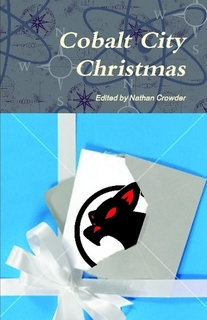
cobaltcitychristmasBook Publishers Northwest web editor Rosemary Jones (who writes fantasy and science fiction in her spare time) contributed to the Timid Pirates’ anthology Cobalt City Christmas.

“This is the fastest publishing project that I’ve ever seen and shows what sites like Lulu can do for a small press,” said Jones. “The idea came up during a discussion in October with Cobalt City creator Nathan Crowder. Timid Pirates invited me to contribute a story by mid-November, along with three other Northwest writers and Crowder.”

The result was a short book (98 pages) of shared world fiction available by the first week of December. The Cobalt City series created by Crowder focuses on the exploits of a group of superheroes. The stories by Crowder, Jones, Angel Leigh McCoy (Horror Writers of America), Jeremy Zimmerman (Crossed Genres), and Nicole Burns revolve around the Yuletide season and its impact on the masked superheroes and their foes in stories ranging from humorous to tender to pure knockabout action.

Espresso Machine Serves Up Books

An announcement that two Northwest bookstores have added Espresso to their store may be met with a “huh, don’t they all serve coffee now?”

Except this Espresso creates books, not lattes, for customers. Village Books in Bellingham and Third Place Books in Lake Forest Park will be installing the Espresso Book Machines in their stores this winter.

According to the manufacturer, the Espresso Book Machine delivers “library quality paperbacks at low cost, identical to factory made books, printed direct from digital files for the reader in minutes.”

With agreements in place with Google Books (announced this week) and Lighting Source, readers will have access to “millions of digital titles in multiple languages, including rare and out of print public domain titles,” said Jason Epstein, Chairman and co-founder of On Demand Books, LLC (ODB), the maker of the Espresso Book Machine.

The machine’s software, ExpressNet, also tracks the printing of copyrighted material and provides for payments to publishers and/or self-published authors.

Social Networking 101 for Authors and Publishers

By Beth Whitman

There are many ways to build your web presence but I’m going to outline here the method that I used to build an online readership.

Start by creating a website
For an easy and inexpensive solution, you can check out Homestead.com which provides basic templates to choose from. For less than $5/month, you can create a site and have it hosted at Homestead. Not great for a site that you want to update often or as a blog, but it is OK for a landing area to direct people elsewhere… like to a blog.

Then create a blog
This is going to be the way you’ll reach your audience. By blogging regularly, even as little as once a week, people will come back to see what you have to say. Free blogging platforms include Blogger, WordPress and LiveJournal. You can also have a blog custom created, one that might include your logo and your own design, for anywhere from hundreds to thousands of dollars.

Blog regularly and start creating your community of readers
Writing a blog is great, but not if no one is reading it :-). You’ll need to alert your friends and family and start getting the word out that you’re blogging.

•    Create posts that tie into your book(s) and become the authority on your topic.
•    Read other blogs and comment on them, linking back to your blog
•    Create a blogroll that includes the other blogs you read and request that those bloggers add you to their blogroll

Start a newsletter
Have a way to capture email addresses and the location of your fans by sending out a newsletter. Constant Contact is a great service for this but there are lots of them out there. Start with friends and family and encourage them to share your newsletter so that it can grow. Include a way on your website for people to sign up for this FREE newsletter and then provide them with relative, pertinent and timely information. Personally, I have found that a monthly newsletter works well but others may find that weekly emails work better.

Social networking
This is where the bigger payoff is. Though it can seem a bit overwhelming, spending a little time every day building up your online social network will eventually pay off and you’ll find dedicated readers subscribing to your RSS feed and buying your book(s).

Facebook – Probably the most interesting and easiest to understand, Facebook connects friends (real and virtual) and allows them to share website articles, blog posts, photos, videos and much more. Start by locating your real friends. Join (or start) groups that have like-minded people and then friend those folks. When you post information about your latest book, they will see this. Drive traffic back to your site and to the pages where you’re selling books.

Create a Fan Page so that people can stay posted about your events, book signings and anything else you want to alert them about. You can find my Fan Page by logging in to Facebook and searching on Wanderlust and Lipstick.

Stumbleupon – Though the traffic from SU isn’t always “sticky” (meaning they usually don’t stay on your site for a long period of time), a good blog post or website article can get thousands of page views and, with little effort, can alert a lot of people about your site and expertise. You’ll want to build up your friends by finding like-minded stumblers and then sending them your articles to stumble and returning the favor.

Twitter – Though it’s not so easy to grasp why anyone would want to be on this site where you are limited to 140 characters in each of your posts, it has become an important addition to the world of social networking. Publicists, other authors and your readers are all on Twitter. Start following them (they are likely to start following you, too) and then post relative content regularly. The more you post and the more people you follow, the more followers you’ll have.

Ning, Google or Yahoo Groups – By joining or starting one of these groups, you’ll be involved with a community of people who share similar interests and may be the perfect audience/ buyers of your book!

Amazon Connects – Your book is already being sold on Amazon, make sure that you are part of their Connects program for authors. Create an author page and feed your blog to it so the world can stay posted on your updates.

LinkedIn – Some would say this is an important social networking tool. I honestly haven’t used it much as an independent publisher. It seems like a great way to network your way into a job and to let professionals know what you’re doing, but it hasn’t been an important tool for me (yet).

Shelfari – Part of Amazon, this is a social networking site for book lovers. Because I try to manage so many other things, I don’t participate here, but you might find it of value.

Goodreads – Similar to Shelfari in that you can social network with other booklovers.

MySpace – Probably more appealing to the younger crowd. Geared toward bands and the performing arts. Quickly surpassed by Facebook and other social networking sites.

The key with all of this is to get the word out there as much as possible to potential buyers. It’s difficult to measure the direct effect that any of these sites have on sales but I’d venture to say that I’d have about 1/3 the sales if I weren’t involved in all of these. In my community, travel, I’d have very little visibility if I wasn’t so tied in to other bloggers, travel writers and, in some cases, PR people through these sites.

Some key tips:
Don’t try to do everything at once. Pick a network that seems most appealing to you. After all, you want to have fun.

Spend 30 minutes a day for a month developing your friends/network. You’ll see how quickly this can grow with just a little time spent daily.

Once you’ve built up the network, spend 15 minutes a day updating your posts, events and other information. There are several programs that you can use that will automatically update your posts to these sites so that, in theory, you wouldn’t have to log on. However, giving these a personal touch is always better than an automated update.

Here are some ways you can automatically update your feeds:

Facebook – You can feed your blog posts into your Facebook account automatically by doing the following:
Manually import your blog to FB (preferred) – I like this method for a number of reasons. It allows me to have control over what images and text appear AND I can add multiple blogs if and when I want to. Sometimes I don’t add a blog post at all and because I currently write 3 separate blogs on my site, I am able to add these throughout the day, rather than having them all upload at once. In order to post manually, you’ll need to add a little widget to your web browse.

Here’s how to set this up so you can add yours manually:
1)    Search for “Applications” in the upper right hand side search box.
2)    Click on the Applications tab
3)    Search for “posted items” in the search box above the applications
4)    Click on the application that says “Links”
5)    Click on Go to Application in the upper left corner
6)    Grab and drop the box that says “Share on Facebook” into the browser bar of your browser. This box can be found on the right hand side of the page under the Post a Link box.

Now after you’ve posted a blog, all you have to do is be ON that blog post, click on Share on Facebook (in your browser) and a popup box will appear where you can choose the image and text to go along with that post.

Note that it’s best to already be logged into FB in order to Share your post but using this applications means you don’t have to go TO FB to create the post (we all know how easily it is to get sucked into FB once you’re actually on the site!).

Automatically import your blog to FB – Unfortunately, with the new FB site redesign, I have not been able to figure out a direct way to find the application needed for this, namely Notes. So, to find it, do the following:
1)    Search on “notes” in the upper right hand search box.
2)    Click on the Applications tab when you’ve got your search results.
3)    Click on the Notes application, should be the 2nd listing.
4)    Click on Go to Application in the upper left hand side
5)    Now look for Notes Settings on the right hand side and click on Import a blog
6)    Import the RSS feed for your blog

Note that you can only import one blog at a time so if you write multiple blogs you can only choose one that is automatically imported.

Twitter – It’s possible to have feeds automatically update your Twitter account. I did this for a year before actually ever using Twitter in any kind of serious fashion. It allowed me to get set up quickly and build some followers but doing little work. I have found, however, that manually adding my Tweets allows me to personalize the tweet and, ultimately, get even more followers. So, while I recommend this as a way to get started, it won’t yield great results unless you are also manually tweeting the same items in a more personalized fashion.

There are probably lots of ways to set this up, but this is how I set mine up a long time ago, so I’ll start here:

1)    Log into Twitterfeed (www.twitterfeed.com) using one of the account sign in options provided in the sign in box.
2)    Click on Create a New Feed
3)    Click on Authenticate at Twitter to make sure that you’re logged into your Twitter account and that the RSS feed will link to that account. Allow access if the account is correct or Deny if it’s the wrong account (then enter the correct account).
4)    Enter your blog’s RSS feed and test it to make sure it’s been entered properly
5)    Note how often you want Twitterfeed to check for blog posts, how you want the url to show up (TinyURL is a good option), whether you want any words to precede your tweet and then click Create.

This will set up your feed to automatically publish to Twitter!

StumbleUpon
Stumbleupon is a social networking site for bookmarking your favorite websites or posts. Once you have made friends with people, at the click of button, you can start “stumbling upon” sites that those other people like. So, if you’re sci-fi geek and have lots of sci-fi “friends” on SU, you can see what sites they like and share your favorites with them.

Besides finding new sites that you might like, SU is great for building traffic immediately on your own site – but the traffic isn’t necessarily very loyal. They won’t stay long, they won’t click on ads and they may never come back. But, by friending the right folks, you may bring some more awareness to your brand, books, services and reputation which could get you more attention and links back to your blog or website down the road.

Here’s a primer on how you might build up your friends and traffic using SU:

1)    Friend as many people as you can. Start with real life friends or acquaintances and then friend the friends of those folks. I tend to friend people who have some sort of travel theme in their name.
2)    Pay attention to those with a large number of subscribers. People with 300+ are the best but you can still be friends with those that have fewer.
3)    Start a spreadsheet that has a row for their SU names, the article name and then the date you request a stumble. Make a note (mine are highlighted in red) next to those with a high number of subscribers.
4)    To request stumbles, usually I go into my SU account, go to my friends tab and start requesting stumbles from people who are currently online. Those people show at the top of your list and then it descends to who hasn’t been online in a long time. (Forget people who haven’t been on in weeks.) I send the people at the top of the list messages using the tab on the far right that says: Send a message. And then I just ask nicely…

Hi,

Would love a stumble on this article if you like it. Comments appreciated!

URL

Thanks and happy to return the favor!

Beth

There is a Stumbleupon application that you need to download into your browser that will allow you to give a thumbs up (stumble) to web pages. Be a good social networker and stumble other people’s posts and pages often. To find the SU toolbar, log in to SU, scroll down to the bottom, look under About and Download the Toolbar.

This same application allows you to send links to your friends for pages you like (like yours!) without signing into the SU homepage. This is the “Send To” link that has the dropdown of your SU friends. I get tons of requests from this and recently decided to stumble the requests I got and then ask for one in return. This method didn’t work so well for me. I hardly got any traffic from these folks. It could be that they aren’t stumbling in return or they aren’t quality stumblers so it’s not making the rounds. So, I’ve abandoned that method and am now only asking people to stumble when I’m logged in and can send them a direct message (see #4).

If you have a person who has a lot of subscribers “Discover” your article (meaning they are the first ones to Stumble it) – you’ll get A LOT more traffic than someone with few subscribers – even if that high volume person eventually stumbles it.

5)    I track everyone I request a stumble from (in that spreadsheet) so that I’m not asking the same people over and over and I’m not asking them too often.

With so many other of the social networking sites, spend 30 minutes a day for a month building up your friends and then start workin’ it to your benefit.

Now go outside and get some fresh air 🙂

Guest Article: Cost of Copyright Infringement

This the second in a series of “loss scenarios” provided by Sinead Murphy of Hiscox.  .

Copyright infringement

Factual background

A large reference-book publisher produces and distributes an illustrated biography of a famous American counterculture band that includes, according to the book’s jacket, “rare and unseen photography” as well as “seminal posters, memorabilia, and ephemera,” along with personal essays and a comprehensive timeline of the band’s history. Included within the book’s historical timeline are seven reduced-sized images of concert posters for which the publisher did not obtain reprint permission.

Litigation proceedings

The copyright holder sues the publisher for infringement, seeking an injunction against further distribution of the book, the destruction of all unsold books, and actual and statutory damages. Following nine months of discovery, the publisher files a motion for summary judgment conceding both that plaintiff owns the copyright in the posters and that the publisher copied the works without authorization but contending that the use of the images in the book constitutes non-actionable “fair use” of the works.

Outcome

The trial court agrees and grants the publisher’s motion, concluding that the book’s use of the copyrighted works was protected because it was sufficiently transformative, made only minimal use of the posters, and did not affect the market for the posters themselves. On appeal, the judgment of the trial court is affirmed.

Costs

The total cost of litigating this case for the publisher would be expected to be approximately $525,000.

Guest Article: Protecting Your Publishing Company

This is the first in a series of “loss scenarios” provided by Sinead Murphy of Hiscox.

Defamation

Factual background

Two authors write a 700-page book entitled “A Guide to Cults and Fringe Religions,” which is published and distributed by a mid-sized publisher of religious-oriented texts. The book contains a 16-page introduction and 57 chapters, each devoted to a different religious group.

Litigation proceedings

One of the groups – which is the subject of a two-page chapter and is mentioned in three other places in the book (once in a chart along with 15 other groups, once in a footnote, and once in an appendix list of 50 religious groups) – sues the authors and the publishers for defamation, contending that the book labels it as a “cult” and that this description has damaged its reputation in the community. Following a ten-month discovery period, the authors and the publishing house move for summary judgment on the grounds that the statements in the book and any resulting implications are incapable of defamatory meaning, that the church is a public figure and cannot prove actual malice, and that the statements are protected by the First Amendment.

Outcome

The trial court denies the motion, but permits an immediate appeal. The appellate court reverses and orders that summary judgment be entered for the publisher and authors because determining the truth or falsity of the church’s status as a “cult” would run afoul of constitutional proscriptions on state involvement in religious affairs and because statements in the book’s introduction describing criminal characteristics of cults are not “of and concerning” the plaintiff group.

Costs

The total cost of litigating this case for the book authors and publisher would be expected to be in the range of $650,000.

5 Tips for Successful TV Interviews

tv interview

By Marsha Friedman

(Marsha Friedman was the April speaker at Book Publishers Northwest)

It has been more than 70 years since television was first commercially available, and in that time we have seen the emergence of radio, wireless communications, the Internet, twitter, and social networking. However, one thing has remained constant in that time. Practically since the first broadcast over commercial airwaves, television has been the most powerful medium of them all – and that fact still remains true today.

A good television interview can change a life. It can change a company, an industry – and in some cases – it has changed the world. That’s why we specialize in helping our clients make the most of their TV interviews. In those few minutes of airtime, you can influence more people than any other communication method. So, to help our clients do it right, I’ve assembled a booklet that will soon be published on our Web site (www.emsincorporated.com) that contains 50 simple tips for doing the best TV interviews possible.

Periodically, I’ll share a few with you, like I’m doing today.  Let me start with my top five, to show you how easy it can be.

  1. Be energetic – This is your message and I’m sure you’re naturally excited about it – so channel your energy and make it work for you. If you are excited and positive, your audience will be very responsive.
  2. Be mindful of body language – TV is a visual medium, so be open with your body language. Make sure to lean slightly toward the interviewer when you are talking and show interest in the conversation. Be aware of where the camera is, even though you are not looking at it.  If you naturally talk with your hands, then feel free to gesture naturally. Your body language shows your confidence and your passion for the topic.
  3. Let your personality shine through – Make eye contact, and talk to the interviewer as if you are talking to a friend sitting in your living room. Speak in an open and confident manner, smile and have fun. Your enthusiasm will be contagious.
  4. Stay focused on your message and keep it simple – Choose a few key points you feel will be most relevant to your interview and outline them for yourself ahead of time.  Keep it uncomplicated to best convey your message. If during the interview, the conversation veers away from them, make sure to steer it back in the most subtle way you can
  5. Know your topic and any current events that relate to it – This should also come naturally. This is your area of expertise, so don’t be afraid to show it. You know your subject inside and out, so explain it as clearly as you can, in as few words as possible. Keep it short and memorable. If it relates to anything that is currently in the news, let people know it. Be prepared and think of all the possible questions and their answers – even the ones you think no one would ever ask. Be ready to catch that fly ball coming from left field.

Television reaches millions with more power and influence than any other medium, so if you’re going to go on the air, make it count. Make your passion, your ideas and your message compelling enough to be worth it to viewers to welcome you into their home, and possibly, into their lives.

If you are interested in finding out if your message is a right fit for a local and national television campaign, contact my partner Steve today on 727-443-7115, Extension 202 or email him by clicking here.

10 Reasons Why Talk Radio is the Best Promotion for Your Book!

on air sign

By Marsha Friedman

(Marsha Friedman was the April speaker at Book Publishers Northwest)

As publicity experts, talk radio is one of the tools that we use everyday to help our clients gain national recognition, promote their books and popularize their causes.  And because it is so effective our clients keep coming back for more!  Fact is – talk radio may honestly be one of the best-kept marketing secrets there is.  There are many reasons why this is true – but let me give you ten to start with:

1. THE RIGHT DEMOGRAPHICS. Every year Talkers Magazine does a research project to profile who’s listening to talk radio.  And, every year their survey confirms that the talk radio listener is, “diverse, educated, attentive, active and affluent…” If this describes your book-buyer – it’s a perfect match!

2. TARGET AUDIENCE. Not only are the demographics of talk radio great – but with specialty talk shows on politics, health, relationships, lifestyles, finance, consumer advocacy, sports, etc., we can identify shows that are a perfect match for your books, once we know the audience you’re trying to reach!

3. EFFECTIVE SALES TOOL. Publicity is definitely not paid advertising.  But it can be far more effective.  Just ask Dr. Arnold Goldstein, well-known financial author, The interest in our books from radio interviews has far exceeded the response we’ve seen from our advertising campaigns.  Dollar-for-dollar, talk radio interviews has shown a much better return!”A compelling radio interview can promote your book without the audience even realizing it!  And, as hosts don’t want to be bombarded with phone calls from listeners with questions about your book, they’re highly motivated to frequently mention your title.

4. THIRD PARTY ENDORSEMENT. Talk radio hosts have loyal followings – that’s how they maintain their ratings.  And listeners tune in daily to hear what their favorite host is talking about. As that host is often thought of as an old friend or even a trusted advisor, when you appear as a guest on their show, listeners hear an implicit endorsement of you, your book and your message!

5. CREDIBILITY. This is a crucial ingredient in every marketing campaign…and talk radio supplies it in abundance!  One of our clients told us, “…every show I’ve appeared on – the host tells his listeners about my great expertise, my many accomplishments and how proud they are to have me as a guest!  Of course, the more important I am, the more important the host appears to be.  As far as promotion and credibility goes – it just doesn’t get any better!”

6. TIME TO TELL YOUR WHOLE STORY. As a guest – you get not just 60 seconds, but ten to thirty minutes of quality time with a very targeted and attentive audience.  You have enough time to talk about your book and in many cases you have a chance to answer questions from callers.  It’s a perfect way to get the full message of your book heard and understood by the masses!

7. COST-EFFECTIVE PROMOTION. Talk radio interviews are all done by phone.  So without ever leaving your home or office you can have a direct and oftentimes live conversation with consumers around the country. Plus our fees for this publicity service are minuscule compared to what you’ll spend in advertising dollars to buy the same amount of air time!

8. IMMEDIATE EXPOSURE. You can be on the air within two to three weeks! And, because talk radio keeps up with changing times and topics, we can continuously create new angles for your topic that reflect current events, to keep you on the air and in the news on an ongoing basis.

9. BEST BANG FOR THE BUCK. With probably 1,000 + talk radio interviews under his belt, nutritional products spokesperson, Dr. W. Wong says, “Talk radio is the greatest way to get your message across to a large group of people at one time.  There’s a captive audience during morning and evening drive times, in the middle of the day with stay-at-home moms and people in the workplace and for those folks awake late at night.  It’s better, cheaper and faster than TV appearances.  Without question – talk radio provides the best bang for the buck!”

10. WE CAN DELIVER THE SHOWS FOR YOU! Scheduling talk radio interviews is second-nature to us.  Talk radio producers and hosts from the nation’s 100 biggest markets have come to rely on us for the steady stream of top guests they need.  In fact, that’s why we’re able to schedule 50 to 100 interviews week after week.

If you want to hear more about our affordable talk radio campaigns to promote your books, call my partner Steve Friedman, today at 727-443-7115, ext. 202 or email him directly at steve@emsincorporated.com.

An Actor’s Script is a Reader’s Friend

podiumA friend once said to me after a reading, “Your book was better than you presented it.” Ow!

But-he was right.

Most people would rather have root canal work done than have to speak in public. Most authors aren’t polished performers; that’s not why we write. Yet a reading is a performance for your book, and you are the voice for your book. How do you give a good performance?

You want to make everyone there, including the bookstore staff, fall in love with you. Your goal is to make everyone there want to take home that part of you which is your book. How?

Think like an actor.

Take the stage, rather than being pushed out onto it. There’s a world of difference. If you take command, it’s a lot less scary. And the best way to take command is to rehearse what you want to say and how you want to say it. Practice will give you control of the conversation.

But you’ve got to really practice: out loud, reading every word of your chosen segments, the full Monty. If you are half-hearted about it you will be self-conscious and thus half-hearted in the bookstore. Warm up your voice, hum to get it forward into the mask, do some mild stretches to stimulate the blood and brain. Warm up like an athlete or a singer would warm up. Don’t go on stage cold.

What next?

A good performance demands rehearsal time. It also takes a script. You don’t need to script the whole event, and probably can’t. Bookstores and other public venues offer distractions-external noises, wandering audience members, crying babies, who knows, I once had a reading disrupted by a rampaging elephant-so a written outline or list of topics to which you can refer can be a life-saver. This will a.) keep you on track, and b.) keep you from forgetting important stuff.

Write a list of acknowledgements to read out. Thank the bookstore staff, and anybody else who helped with the event or the book, especially if they are present. This is vital. It’s how you get asked back; it’s how you get people to want to do favors for you. And you will need them.

Chief among the announcements, say at least three times (beginning, middle and end), “I will be happy to autograph copies later, they are on over sale there”-and point-at the sales location. This warms the hearts of the staff and plants the idea in the minds of your listeners. Why three repetitions? Snarky old advertising proverb: What I tell you three times is true.

In your presentation, you can’t just drone out a reading and sign books. You need to connect with your audience on a personal level. So address these three questions: what made you write the book; why you were the person to write it; and will you tell personal stories about either the writing of the book or the incidents in it? Intersperse your short reading selections in with your response to these questions.

What will you read? Unless you have an audience that is comfortably seated, and there for the whole duration of your appearance, it is best to stay with short segments, 2-5 minutes or so in reading time. A bookstore audience may include people who stop for a moment to listen; if they can hear the entire Noodle Incident, or the story of Aunt Gladys’ toupee, they are more likely to stay for more, or to remember the book for later purchase. Chose pieces to read that exhibit the best qualities of your book-dialogue, relationships, action sequences, whatever. And always have a dead safe fall-back selection ready and practiced in case a group of eight-year-old girls appear in the first row.
When you rehearse, read through each of your selections three times aloud, while timing yourself. Average the times of the second and third repetitions to establish your performance time.

Always use the same text for rehearsal and for performance, so that the page is comforting and familiar to the eye. Some authors use pages, rather than a book. This allows them to print in larger type fonts for easier reading. When looking up to make eye contact with your audience, use your thumb on the text to keep your place, just like they taught you back in grade school.

Read it aloud a fourth time. With a pencil, mark the text where you want to take a breath, where you want to pause, or for any dramatic effects you wish to include, slowing or speeding up dialogue. When you wrote the book did a certain character have a high squeaky voice in your head? Will you read it that way?

Last of all, have a graceful way to close. You’ll take questions from the audience of course, but practice a short smooth exit from your presentation. If things start going sideways during your reading (you’re not feeling well, or your bookie has arrived) you can use it at anytime as a way to close. Some variation of the theme of your book, or why you had to write it, coupled with a thank you to the audience for being interested in the story is always good. As for those questions, always bring three pump-primers with you, in case nobody is willing to start out. If there are no questions after yours have run out, make your third and final shout-out to the bookstore sales people and announce you will now be signing.

All right, now you have a script. It’s rehearsal time.

You’re going to put on a show!

Peter Kahle is the co-author of Naked at the Podium: The writer’s guide to successful readings. He teaches seminars on writing and presentation skills. He is a past president of the Pacific Northwest Writers Association and a member of Seattle Free Lances and Book Publishers Northwest. Email at info@74thstreet.com.

His books can be found at www.74thstreet.com, the web site of 74th Street Productions.

Will It Play in Peoria? Every Publisher Can Take a Pulse

haikuforcoffeeloversGroucho Marx made the phrase popular in the movie A Night at the Opera, but everyone watching vaudeville knew what it meant when someone asked, “Will it play in Peoria?” If a new show was successful in that Illinois city, a demographic microcosm of Midwestern values, then the show could gain mainstream acceptance in the rest of the country. Many performers before and since have cut their teeth in Peoria to find out.

As both a publisher and an author, I have to listen to the customer. If my friends and family think my work is great, that’s nice to hear, but fairly insignificant. What a wider group of prospective readers thinks matters more. And there are some things every publisher can do to improve the odds of seeing whether a book will fly after launch.

How It Works with My Haiku

I write and publish a series of humorous haiku gift books. Each of the 100 17-syllable pages per book is a chance to elicit a chuckle or bomb miserably.

The writer in me thinks I’m hilarious. But the publisher in me remembers something my college choir director said once to other choristers: “You know, one in ten of David’s jokes is incredibly funny. You can’t believe how funny he can be,” he said. “The problem is, you have to listen to the other nine to get to it.” It hurts to admit it, but he wasn’t far off.

Do I know which jokes will get the laughs? Of course not. If I knew how to craft a winner every time, Jay Leno and David Letterman would be fighting for my services. But I know something about the process of finding out. After Leno finishes taping a show, he goes out to a local comedy club and tests material for the next night. What they laugh at tonight, we may laugh at tomorrow.

So I write 150 to 200 haiku per book. And then I assemble a team of guest editors-one to two dozen people with knowledge, expertise, or interest in the book’s subject area. Friends and family get asked too, and they give a helpful baseline from book to book, but I ask a different group for each book, including professionals.

For example, casino dealers looked over Haiku for Poker Players and baristas read Haiku for Coffee Lovers. The latter had a team of 13 guest editors. Thanks to their reactions-

Internet access
in my local coffeeshop:
I’m wired and wireless

-made it onto the back cover.

But –

okay, I’ve showered,
dressed, and finished my first cup-
hand me the paper

-fell flat and missed the cut.

The most polarized vote was for a haiku that originally read-

No, stupid, I’m the
double tall nonfat no foam
sugar-free mocha!”

Marginal notes made it fairly clear that the problem was the word “stupid.” So I changed the first line to “Excuse me, I’m the” and published it.

Guest editors can also tell me when I misuse a term as well as which jokes fall flat. If I tell a joke, and they don’t get it, something’s wrong! My wife has made a first pass at copy editing by the time guest editors see it, but occasionally they catch something she missed. (A professional copy editor makes a last pass once the final 100 have been selected.)

I ask guest editors for an immediate gut reaction. The haiku come with a one-page instruction letter that shows how to quickly check, X-out, question, or flag a haiku for its quality or problem. Most guest editors are done in 10 to 20 minutes and mail the haiku back to me in a self-addressed, stamped envelope. I give each guest editor a free copy of the book when it’s done and put their names in the acknowledgments.

Then I count the votes for each poem, focusing on checkmarks (liked it), question marks (didn’t get it), or Xs (didn’t like it) and come up with a formula to rank the haiku. Most people use Xs sparingly, so an X might subtract two or three checkmarks from the score. Question marks might subtract half a checkmark. Once the spreadsheet sorts the scores, I have 90 or more I can be optimistic about, and then I look at the ones on the borderline to choose the remaining 10.

The ones that don’t make it go into a reject file. Over time, I have found patterns that tell me what might be more likely to get an X. Now I write a little differently, hopefully creating better initial material. I’ll never just write 100 haiku and go straight to press, but progress is good.

Applying the Process

It’s easy to imagine using the same system for other kinds of compilations, although it may be harder to recruit guest editors for longer material. But what if your book isn’t a collection of haiku or anything else? Whether you’re publishing mystery novels or instructional guides, you can still use this process. It works on books with continuous, orchestrated text too. Put together a team of trusted readers, or visit an existing and appropriate book club; they’ll be thrilled you’re asking for their opinions.

What you give your guest editors will, of course, depend on your book and your sense of how they can best participate in shaping it. Maybe you’ll want to write 10 different versions of cover copy and see if a couple of them stand out for your panelists. You could try different titles and/or present blurbs (existing or to come) and ask if they’d persuade these readers to buy your book for themselves or a friend. If you have a novel, try asking guest editors to read the first 20 pages and see if they’re hooked or if they have problems. For nonfiction, ask whether the table of contents covers what they want to know, and see what’s missing. You might just learn what your target market thinks is valuable.

Wouldn’t it be great if every author did something like this? Well, maybe. But even comedy has many different markets. You may love Bob Newhart and hate Don Rickles, or vice versa (or you may be asking, “Who are they?”). It’s important for guest editors to represent the right readers for a book. And it’s also important to remember that markets change over time. Did you know that Peoria, Arizona, is now larger than Peoria, Illinois?

Your gut may still tell you what content works and what doesn’t. But your customer should be consulted every now and then to make sure your gut is right. You don’t want your opera to close after just one night.


David Ash is CEO of Basho Press, which publishes the Haiku for Life® series of humorous gift books. Formerly a newsletter editor, entertainment reporter, radio announcer, and choir director, he says he thinks being a publisher looks sane and stable by comparison. To learn more, visit BashoPress.com.  This article originally appeared in the February 2009 issue of the IBPA Independent and is reproduced here with the kind permission of IBPA.