How Every Author Can Benefit from Blogging

Blogs offer authors a powerful tool to develop content, build an auidence for their work and market the finished book.  Blog shave everal key advantages in this regard, including:

  • Blogs are a special type of website. Due to their generally heavy use of links and their relatively frequent updates, blogs tend to rank well in search engine results. These factors makes them an attractive tool for building an audience around your content.
  • Blogs are very similar to book in structure making it easier to transition from blog to book.
  • Blogging offers you the opportunity to establish a relatively painless writing discipline. Blog posts are typically just a few short paragraphs, about 300-500 words in length. Posting with a regular frequency lets you build your book’s content in a measured and disciplined manner. As your blog’s readership builds and you realize you are writing for an audience that wants to consume your content, the task becomes easier.
  • Blogs are very measurable. You can track your readership to a very specific degree. This is important because having an audience and knowing who your readers are is valuable information for publishers. The statistics you collect can also help you decide which content is popular and valuable, and which might be better omitted from your book.
  • Finally, because it is easy to search and find blogs discussing the topics you are writing about, the blogosphere is an effective medium in which to market your completed work.

survey takerFirst consider the size and structure of the blogosphere.  The popularity of blogs has soared in the last few years.  There are now over 100 million blogs tracked by Technorati, which doesn’t even include the more than 70 million Chinese blogs.  According to recent demographic surveys by the Pew Internet Study and the New York Times / CBS News, blogs have become mainstream and represent virtually every audience and topic area. 

Blogs focused on a given topic tend to link to similar blogs.  What this means is you can use blogs to:

  • Develop an audience for your work while you write
  • Promote your book effectively and at low cost once it is written

A blog bears many resemblances to a book. Both have a title and subtitle that reflect the content of a book. Blog posts can be organized into categories which serve as a kind of table of contents to classify and group related material. Blog posts, typically 300-500 words in length, represent the raw content of a book. Links within posts or on the blog roll serve as a bibliography, showing references to source material.

man on soapboxHow do you attract people to your blog? Initially, through searches individuals make on popular search engine sites like Google, Yahoo, Ask and MSN. By using popular keywords in your blog title, subtitle, categories and posts, your blog will begin to turn up in these searches. You can discover these keywords using keyword discovery tools or simply checking out popular blogs in your topic area. The more you blog, the more others discover and link to your blog content, the higher will be the ranking of your blog site in search results, and the greater the traffic you will receive.

Blog software usually provides a basic set of statistics that allow you to track important information such as number of visitors, page views, referring sites and average time spent by each visitor. Page views and comments left by visitors for specific blog posts provide an indicator of popular content. This makes blogs an excellent way for you to field test and select material to be included in your book.

Once you have cultivated an audience, you can transform your blog into a great marketing platform. For example, you can:

  • Feature your book on a special blog page, with your bio, a book description, excerpts, press releases and testimonials; thus your blog can double as a book website.
  • Promote your book to a wider audience by arranging a blog tour.  A blog tour is a series of scheduled guest appearances on related blogs, where you have the opportunity to talk about your book. This is a low cost, high impact method to discover new readers for your work. 

The blogosphere is not the only place to market your work, but it can one of the best. 

manuscript by computerWhether you are publishing independently or trying to sign on with a traditional publisher, blogging can be key to your success. More publishers are now starting to view the blogosphere as a fertile ground to find promising writers. Why? As an author who blogs, you can quantify your audience and this is attractive to risk averse publishers.  This is, in essence, the new author book pitch.

Blogging is a low risk, low cost way to build your audience while you are developing your work, and then promote your finished book to that same audience. Give it a try!

31 Ways to Prepare for Small Press Month (March)


1. Contact your local bookstore or library and suggest they put together a special display for National Small Press Month. You can obtain posters from: Small Press Month Coordinator at IBPA, the Independent Book Publishers Association, 627 Aviation Way, Manhattan Beach, CA 90266, Phone 310/372-2732. Or email April@ibpa-online.org. Please order in sets of two.

2. Suggest that your local bookstore offer a discount off Small Press titles this month. Offer a special discount on all of your titles.

3. Hold a seminar on “How to Get Published” or on a subject related to your books. You might wish to cooperate with other small presses in your area to get this event off to a roaring start. You might wish to charge a nominal fee for the seminar.

4. Contact the book review editor at your daily newspaper about any events that you plan. Also speak to the features editor. The business editor is always interested in a successful publishing story.

5. Send IBPA your list of participating bookstores and libraries so that they may recieve Small Press Month Materials.

6. Be sure to inform IBPA and The New York Center for Independent Publishing (NYCIP) about any activities you have planned for Small Press Month. IBPA would like to include your information when contacting the media. Please send your plans to Lisa@ibpa-online.org.

7. Get in touch with weekly papers in your area about events and submit the information to the listings editor.

8. Approach an interviewer at a local radio station about airing a segment regarding the problems and rewards of running a small press, or set one up for an author.

9. Make arrangements with any local non-bookstore outlet that is appropriate for any of your books. For example, if you publish cookbooks a grocery store might display them up near the check-out for Small Press Month, particularly with a special discount as an incentive.

10. Try for an interview at your local daily paper or the weekly paper, remember that the media is always pleased to find that there are successful publishers and writers in the neighborhood. So pitch not only yourself, but also your colleagues.

11. If you have a personable, articulate author who is available to speak in his or her area, try setting up interviews with local television or radio stations.

12. Schedule an interview for yourself at your local television station for National Small Press Month. Be sure to offer visuals if available. Footage of an author doing exciting research in a jungle, a sports book author on the ski slopes, for instance, would be helpful to getting TV time. Focus on the unique angles of your books and authors.

13. Band together with other small presses and compile a display of titles in a subject area. Offer your library the ready-made exhibit of locally published books in the areas you choose.

14. Find a college or university that would be receptive to a roundtable discussion on a topic like “What is a Free Press” or “The First Amendment and the Mass Media.”

15. Schedule a talk to elementary, junior high, or high school students about how to become an author which could be a highlight of school programs during the month.

16. Use excerpts from a current or upcoming book on your website. Remembering that an entire excerpt, a whole recipe, for example, is more productive than a tantalizing tidbit.

17. Arrange readings and signings from your list to be held during National Small Press Month at your local bookstore and library.

18. Plan a group reading or event with other local independent presses and make a night out of it.

19. Take National Small Press Month posters to your local bookstore or library and be sure that they are displayed and distributed.

20. Join with other small presses and take out a co-op ad in your local newspaper.

21. Be sure that clubs or local organizations to which you belong display a poster about National Small Press Month and has your catalogue available as a handout for Small Press Month.

22. Keep your alumni magazine up to date about you and your small press.

23. Host a wine-a-cheese party in your office for the press, booksellers and other friends of your publishing house. Celebrate National Small Press Month!

24. Gather together all your press cuttings and document the successes of National Small Press Month and please send to Karin Taylor for use next year. Send to The New York Center for Independent Publishing (NYCIP), 20 West 44th Street, New York, NY 10036.

25. Link to the Small Press Month websites from your own: www.smallpressmonth.org or www.ibpa-online.org.

26. Send out e-mails to your customer mailing list announcing the approach of National Small Press Month, and the events you have planned. A weekly digest of news would be an effective way to keep the momentum going throughout March.

27. Contact other small and independent arts organizations in your area – record labels, theaters, and art galleries, for example – and link to each other’s websites, promote each other’s events, and support the independent arts community!

28. Run a contest through your e-mail newsletter, asking for ten titles of famous independently published books.

29. Contact other independent publishers and set up a small book fair during the month at a local college or community center.

30. Evaluate author’s pitches. Offer to set up a program at a bookstore or library where authors, with the understanding that you are there to give general advice, can make a five minute pitch to you about their manuscript.

31. Look over the previous 30 suggested ideas and let us know which ones provided the most response.


Provided by:
Lisa Krebs Magno
Assistant Director
Independent Book Publishers Association (formerly PMA)
627 Aviation Way
Manhattan Beach, CA 90266


E-mail: lisa@ibpa-online.org
http://www.ibpa-online.org

Guest Article: Three Tips For Successful Readings


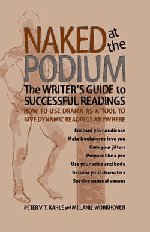
Author, teacher, director, Peter Kahle is a past president of the Pacific Northwest Writers Association and co-author of Naked at the Podium: The writer’s guide to successful readings. 74th Street Productions ISBN 09655702-3-1


1.) Turn On The Speakers In Your Head

•Prepare yourself before you go onstage, as MC or as the Main Event. Your head has a built-in speaker system to make your voice fuller and more powerful. Your sinuses can resonate your voice.
•Hum. Search for the note that feels best in your throat. That is the power center of your vocal range. Hum until your lips buzz faintly. That brings your voice forward into the mouth, and into your speaker system.
•Tongue-twisters to get your mouth ready. Phrases from your report, or generic ones like Peter Piper or ‘Red leather yellow leather black leather yellow leather.’


2.) How To Handle A Heckler

•Your first response? Read the room. Is there staff present? Someone sitting down beside the heckler can help control the situation. The author may not need to respond at all.
•Think of school teachers, how they retain their cool and keep control of the situation. Or think Don Rickles, or Chris Rock, and shoot back. The book in question should determine the response. Depends on how quick you feel.
•Say “Thank you,” and move on instantly.


3.) Carry Your Own Questions (2 copies)

•Never rely on the audience to ask the first question. Don’t let the silence drag out too long, or people feel uncomfortable.
•Always prepare 3 questions about the book. If you can find a shill in the audience, give them your list. Will booksellers be present during the Q & A? Share question lists BEFORE the event begins.
•Design your questions so that the answers lead to other questions. Rehearse, rehearse, rehearse.

For more information see our web site at www.74thstreetproductions.com